Land Reform in Cameroon The Second Session of the Multi-Stakeholder Platform for Consultation Validates the Key Policy Decisions on Land Tenure and State Property Reform
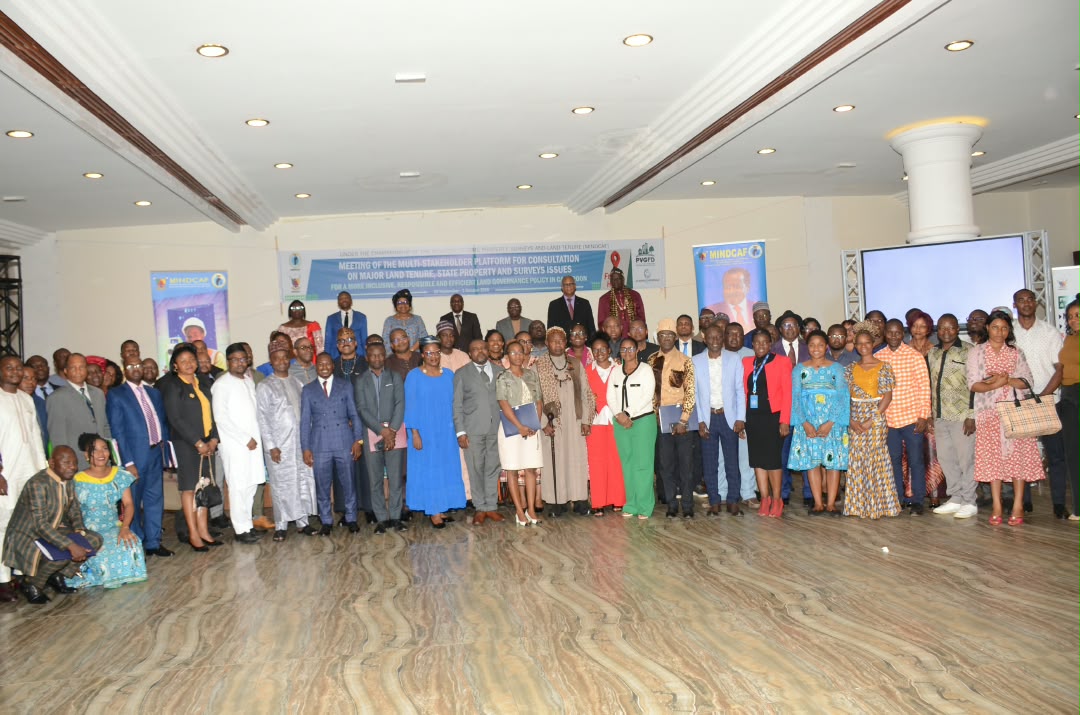
At the end of two days of deliberations held at Franco Hotel in Yaounde on 30 September and 1 October 2026, stakeholders involved in land governance concluded, on Thursday, the second session of the Multi-Stakeholder Platform for Consultation (PMAC), chaired by Henri Eyebe Ayissi, Minister of State Property, Surveys and Land Tenure.
Opened on Wednesday 30 September 2026, the session was devoted to the review of the diagnosis of land tenure, State property and surveys management in Cameroon, presented by the Technical Assistant to the Sustainable Cities and Land Management Project (PVGFD), Dr Samuel Nguifo. Discussions focused on the need for a multipurpose cadastre capable of generating revenue, drawing on the experiences of Morocco, Mali and Nigeria; the distinction between urban and rural land tenure; the suitability of a moratorium on land allocation; the devolution of legal personality to traditional chiefdoms; the regulation of the concept of indigenous peoples and the strengthening of inter-ministerial coordination.
The proceedings were organised into five thematic groups: public administrations; MINDCAF; the private sector and professional bodies; local communities and indigenous peoples; and women and young people. These groups contributed to enriching the draft National Land Tenure and State Property Policy Paper.
Among the recommendations put forward were the submission to MINDCAF of letters designating the stakeholders; the establishment of a monitoring unit within each institution represented; the creation of a National Agency for Surveys and Land Information; and the strengthening of the subsidy policy for State-owned companies such as MAETUR, SIC and MAGZI.
In his closing address, Minister Henri Eyebe Ayissi commended the maturity of the multi-stakeholder dialogue, which has become “A leading platform for collective intelligence at the service of land governance.” He stated that the contributions gathered would consolidate the pillars of the strategic vision, notably the securing of customary land rights; participation of traditional chiefdoms in the management of parcels of national land; the economic optimisation of national land assets; the comprehensive digitalisation of the land registration system and land registries; as well as the cross-cutting mainstreaming of gender, decentralisation and climate-related requirements.
Government’s roadmap will henceforth revolve around three key milestones: the finalisation of the reference National Land Tenure and State Property Policy Paper; the convening of the Inter-Ministerial Team responsible for finalising the reform; and the launch of inter-regional consultations on the implementing instruments of the forthcoming law on land tenure and State property.
The Minister expressed Government’s gratitude to the World Bank, a leading technical and financial partner through the PVGFD, jointly implemented with the Ministry of Housing and Urban Development, as well as to the FAO, GIZ and United Nations system agencies. He also commended the commitment of civil society organisations, women’s and youth networks, and paid tribute to traditional authorities, wo are the “sacred guardians of our lands and traditions”.
The proceedings of the second session of the PMAC were officially declared closed.
Nick Didace BEKEAKEN